To unlock the potential
of natural hydrogen to power
Australia’s energy transition.
Unearthing the future
of clean energy
Natural hydrogen is more than just another energy source – it’s a paradigm shift in how we think about clean energy. While the world grapples with carbon-based fuels and costly hydrogen manufacturing, Earth has silently produced natural hydrogen for billions of years through natural processes. We discovered this truth through decades of exploration experience. It led us to a profound realisation: the next great energy revolution won’t come from manufacturing hydrogen – it will come from finding it.
Today, we’re pioneering this revolution across Australian territory, combining deep exploration expertise with groundbreaking academic research to contribute to a sustainable, economically viable energy future. Natural hydrogen is the game-changer we’ve been waiting for — lower environmental footprint, minimal water use, and a fraction of the cost of manufactured hydrogen .
We’re Gehyra. And we’re explorers with a purpose.


Krista Davies
Krista Davies
Krista Davies is the Founder and Managing Director of Gehyra Energy, and has served as the company’s Technical Director since its inception in 2021. A geoscientist with 30 years of upstream exploration experience, Ms Davies is recognised as one of Australia’s leading technical voices in the emerging field of natural hydrogen.
Her career spans senior exploration roles across onshore and offshore basins, working with companies ranging from agile small caps to multinational oil and gas operators. Her expertise in sequence stratigraphy, seismic interpretation, and frontier prospect generation has driven the discovery and maturation of multiple plays across Australasia and Southeast Asia.
Dr Davies is at the forefront of Australia’s natural hydrogen sector, combining rigorous field science with innovative exploration workflows to unlock new geological energy systems. Since 2021, she has led the development of Gehyra’s portfolio of hydrogen and helium exploration licences, applying cutting-edge soil gas detection and subsurface characterisation methods to identify high-potential accumulations.
In 2025, she completed a PhD in Hydrogen Subsurface Geochemistry at the School of Engineering, Edith Cowan University. Her doctoral research focused on de-risking hydrogen storage and exploration through long-term soil gas monitoring, headspace gas analysis, and hydrogen-induced mineralogical transformations — establishing foundational insights for the industry.
Krista also holds a Master’s degree in Environmental Management (Inland Aquatic & Marine Systems) and a First Class Honours degree in Geology. Her approach to exploration is grounded in a commitment to scientific excellence, environmental responsibility, and practical innovation — ensuring that clean energy discovery goes hand-in-hand with sustainable development.

Andy Oldham
Andy Oldham
Andy Oldham is a seasoned exploration geophysicist with over 35 years of experience in the oil, gas, and emerging hydrogen sectors. He is currently Non-Executive Chair of Gehyra Energy Pty Ltd, a pure-play hydrogen and helium explorer with assets across Australia.
Mr Oldham has built a reputation for leading high-performing exploration teams and driving successful programs across complex geological frontiers. In his current role at Gehyra Energy, he provides strategic oversight to one of Australia’s most active natural hydrogen exploration companies.
Prior to Gehyra, Mr Oldham served as Director of Exploration at Ophir Energy, where he led multi-disciplinary exploration programs across Africa, delivering material discoveries and portfolio growth. Before that, he held senior roles at Woodside Energy, managing frontier exploration campaigns across West, North, and East Africa, and overseeing technical assurance across the company’s international exploration division.
Mr Oldham’s early career included a decade at Santos, where he worked across the Cooper Basin, Timor Sea, and Browse Basin. He began his career on seismic crews in remote parts of North Africa and central Australia, developing deep operational expertise in challenging environments.
Throughout his career, Mr Oldham has demonstrated a consistent ability to translate geological potential into exploration success, building strong teams and delivering results across both mature and frontier basins.

Eytan Uliel
Eytan Uliel
Eytan is an experienced energy executive, investor and corporate finance specialist with more than 25 years’ experience across the oil and gas, natural resources and investment banking sectors. He is currently President and Director of Sintana Energy Inc. and formerly served as Chief Executive Officer of Challenger Energy Group Plc, where he led the company’s international exploration and development strategy.
Prior to this, Mr Uliel held senior executive and board roles with a number of energy and finance companies including Dart Energy Ltd, Arrow Energy, Armour Energy Ltd and Babcock & Brown. His background spans corporate law, mergers and acquisitions, structured finance, private equity and global energy project development. Mr Uliel holds law and commerce qualifications from University of New South Wales and has extensive international experience working across Australia, Asia, Europe, North America and the Caribbean.
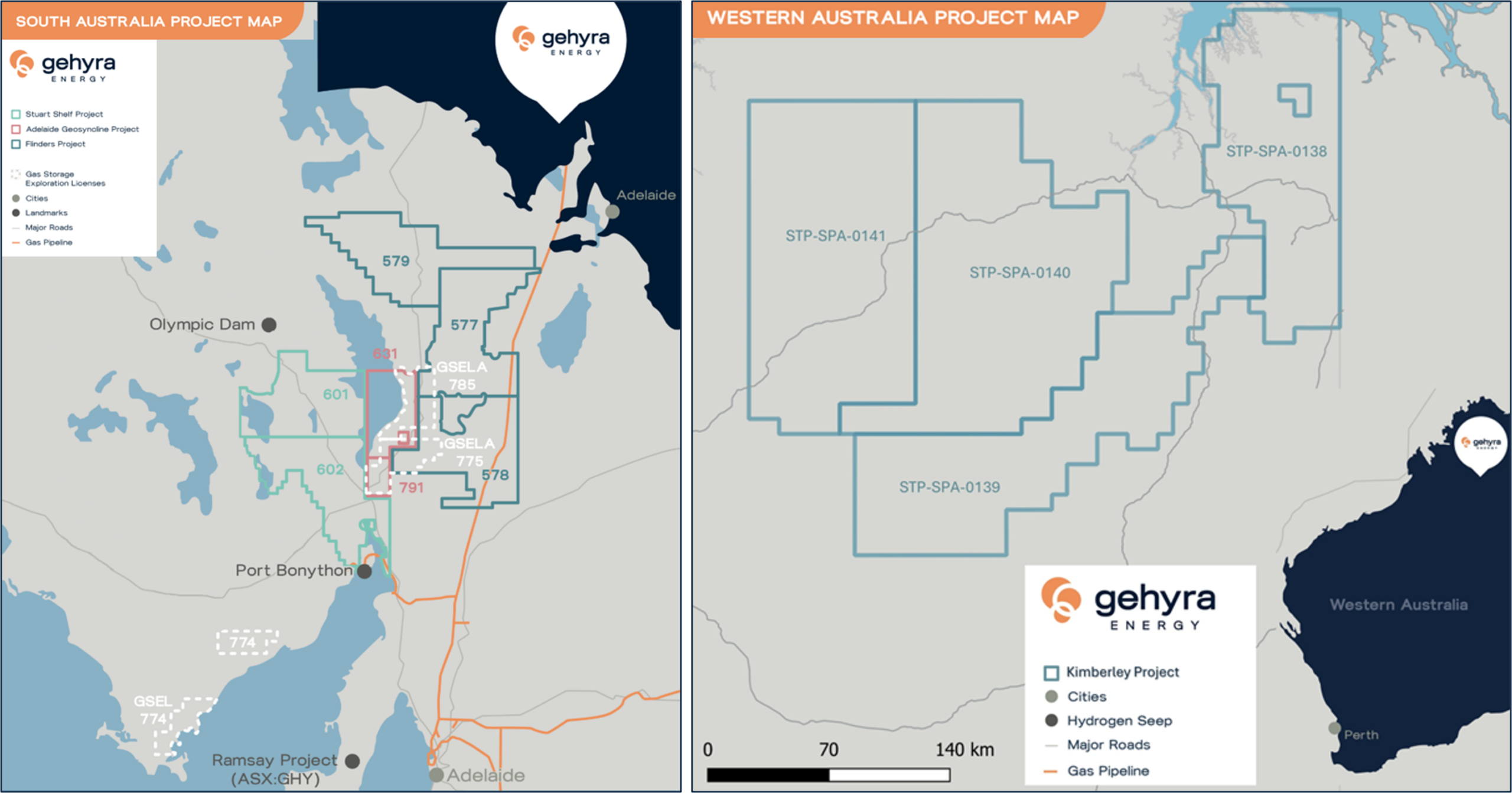
Strategically located over Archean-Proterozoic basement provinces

South Australia

Multiple Resources

Underground Storage Potential

Kimberley
Frequently Asked Questions
Natural hydrogen, also known as white, gold, or geologic hydrogen, is formed through natural processes in the Earth’s subsurface. Similar to how fossil fuels are created over time, natural hydrogen is generated without human intervention and is a primary source of energy.
At Gehyra, our exploration efforts focus on identifying and extracting these naturally occurring hydrogen resources.
Natural hydrogen is different from grey, blue, and green hydrogen in that it occurs naturally in the Earth’s crust and is extracted directly from geological deposits, unlike the other types, which are produced through various industrial processes.
Grey hydrogen is made from natural gas through a method called steam methane reforming, which emits significant amounts of CO2. Blue hydrogen is also produced from natural gas but with carbon capture and storage (CCS) to reduce emissions. Green hydrogen is produced by electrolysis using renewable electricity, resulting in zero emissions.
Natural hydrogen stands out as it is a naturally occurring resource with much lower environmental impact, as it requires minimal energy to extract, and does not involve the emissions associated with grey or blue hydrogen production.
Recent exploration has shown promising results with high concentrations of natural hydrogen. For instance, on South Australia’s Yorke Peninsula, hydrogen concentrations of up to 96% have been measured at the Ramsay Project.
At Gehyra, our strategic portfolio approach, which covers multiple play types across over 125,000 km², increases our chances of significant discoveries and lies along geological trends with recent results.
While some skills are transferable, natural hydrogen exploration requires a unique approach. Current industry understanding Is that natural hydrogen Is generated in different geological settings and demands tailored exploration techniques.
At Gehyra, we’re pioneering these methods through our research partnerships and by combining best practices from mining and oil & gas industries with cutting-edge academic research, including advanced soil gas sampling and geophysical surveys.
Natural hydrogen extraction has a dramatically lower environmental impact compared to other energy sources.
Our exploration and production methods are designed to minimise surface disturbance. Natural hydrogen extraction has a significantly lower environmental footprint than manufactured forms of hydrogen. It also requires minimal water usage, unlike green hydrogen production, which can be water-intensive.
When used as a fuel, natural hydrogen produces zero carbon emissions.
We believe natural hydrogen could offer a 97% reduction in total greenhouse gas emissions compared to natural gas when used for power generation.
While still emerging, the hydrogen market is growing rapidly. Global hydrogen demand is projected to grow from about 90 million tonnes in 2020 to 140 million tonnes in 2030. Australia’s national hydrogen strategy aims for the country to become a major producer and exporter by 2030, and Gehyra is well-positioned to contribute to this goal.
While hydrogen is highly combustible and must be handled carefully, it is nontoxic nor poisonous. The natural hydrogen industry Is following best practices used by the oil and gas industry over the last 50 years for safe storage and handling of flammable materials. As technology advances, storage and transportation methods will become increasingly safe and efficient.
We are targeting production costs for natural hydrogen as low as $0.5-1.0/kg and significantly undercutting manufactured low-carbon hydrogen. Extraction requires minimal processing and doesn’t rely on large-scale renewable energy infrastructure for electrolysis compared to manufactured hydrogen.
This cost structure could make hydrogen viable for applications previously considered unfeasible, including low-carbon baseload power generation, carbon-free fertiliser production, and even sustainable aviation fuel at near cost parity with traditional fuel.
Hydrogen has a wide range of applications. It is used as an energy source, particularly in fuel cells to generate electricity for vehicles and other power systems, emitting only water as a byproduct. Hydrogen plays a vital role in various industrial processes, including the production of ammonia for fertilizers and petroleum refining. Hydrogen is increasingly seen as a key player in the transition to sustainable energy, offering potential for decarbonising multiple sectors.
Ready to learn more?
Speak to our expert team today and discover how Gehyra is shaping the future of clean energy.